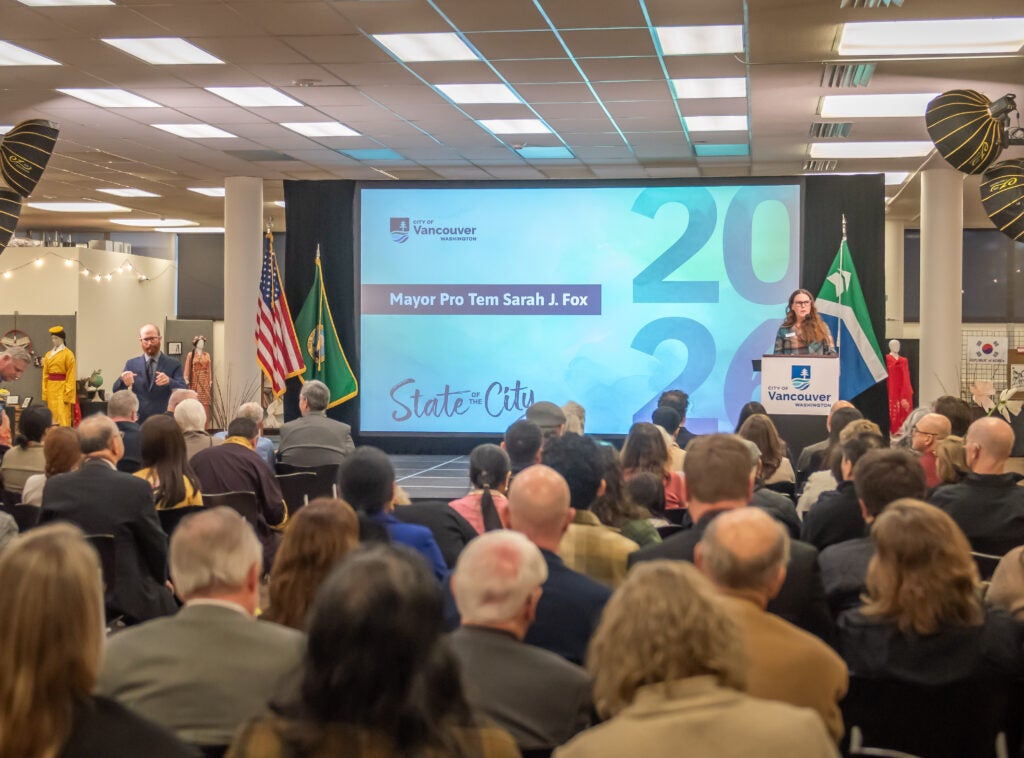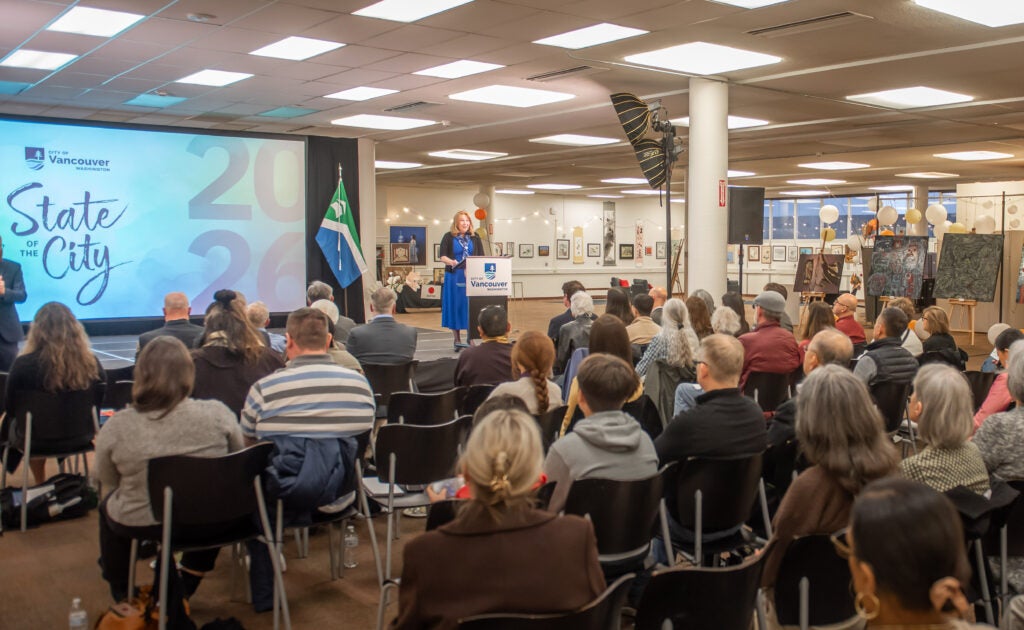


2026 State of the City
Watch the address
Speech transcript
Mayor Anne McEnerny-Ogle
March 6, 2026
Español, Русский, Tiếng Việt, 中文 and more language translations are available using the translation tool located in the upper right-hand corner of this page.
Thank you, Sarah … Good evening and welcome.
Wow, what a great way to start!!!
Let’s show our appreciation one more time to the Vietnamese Community of Clark County dancers and Poet Laureate, Susan Dingle.
I always look forward to seeing so many of you at this event, and I would like to extend a warm welcome to those who are watching online. Thank you for choosing to spend your evening with us tonight.
I’d like to take a moment and recognize my colleagues on the Vancouver City Council who are with us tonight. Please stand up to be recognized.
We have many distinguished guests this evening… And I would like to recognize our elected officials here with us from Washington State, different counties and cities. Please stand up so we can honor you.
Let’s start by congratulating our City Manager, Lon Pluckhahn, on recently completing his first year in the role… Thank you, Lon.
His leadership has been instrumental as we navigate both the challenges and opportunities of the times we are in.
We can see how his steady guidance is helping move our community forward.
As we continue working together to support our community, there’s an issue weighing heavily on the Council and many of our residents, that we need to address.
I want to acknowledge the fear, uncertainty, and frustration many in our community are feeling and experiencing around ICE activity.
Their conduct in and around our neighborhoods has caused real harm and destabilization, and that impact is ongoing.
In January, the Council issued a declaration denouncing the actions of federal immigration enforcement agencies.
Our work includes ongoing conversations with our community stakeholders, exploring options to expand resources, and ensuring people have access to information that supports their safety and well-being.
We are also committed to pursuing every avenue available to us and using the force of our authority to limit ICE’s reach and protect our community.
Even as we confront these challenges, 2025 was a year defined by meaningful progress across our city.
From major projects to the essential services the City delivers every day, we saw the results of steady leadership and strong partnerships.
Together, we advanced key priorities, strengthened core services, and delivered work that reflects the values and expectations of our community.
One of those expectations is a safe community.
Last year, the Vancouver Police Department responded to over 100,000 calls for service. Vancouver operates the second-lowest-staffed police department among Washington cities.
And after the narrow loss of the first Police Services Levy in 2024, the issue remained; so we listened, learned, and significantly scaled back our ask to reflect the community’s priority of more officers.
And last November, we passed Proposition 5. Thank you!!!
Proposition 5 funds 13 new officers and provides the vehicles and equipment needed to ensure they are fully prepared to serve the community.
This means one additional officer on every shift to improve response times and coverage citywide, along with a dedicated child‑crimes detective to better protect vulnerable youth and investigate sensitive cases.
We’re actively recruiting applicants so we can get new officers on the street quickly.
I want to thank the Police Advisory Committee for helping us refine what we asked for. Your leadership was critical to shaping what ultimately appeared on last November’s ballot.
Last year, Fire Chief Blue retired after 38 years of fire service. We launched a national search for our new chief, and we found him.
I want to welcome our new Fire Chief, John Drake, to Vancouver.
As our new Chief, he is getting to know the community and the department so he can focus on meeting the evolving needs of Vancouver’s growing community and fulfilling the commitments of the voter-approved Proposition 2.
Our previous Chief, in partnership with General Services, honored the commitments we made to the public in Proposition 2 and created a strong foundation for Chief Drake to build on.
Last year, we started designing the remodel of Station 8 in Cascade Park. It was built in 1971 and has one of the highest call volumes in Vancouver. We expect construction to start later this year. And we’ll start the design phase on stations 3 and 6 later this year.
Community safety also means continuing to provide our customers with safe, high-quality drinking water.
The City continues to make meaningful progress in our work to address PFAS.
This has included seeking funding that doesn’t rely on asking homeowners to foot the bill. To date, we have brought in $64 million in forgivable loans and grants.
We will start construction on the treatment system for Water Station 14 this summer and have system upgrades planned for 4 other water stations.
In addition to investing in our filtration systems, we are also evaluating new groundwater supply sources as a potential PFAS mitigation option for our smaller wells.
Addressing PFAS is one part of our responsibility to protect our public and natural resources. That same responsibility guides our work on climate change.
In 2022, we adopted the Climate Action Framework as our roadmap, and over the last three years, the City has worked to further our commitment to climate action.
In 2025, we adopted the Green Building Program that balances ambitious standards with cost and feasibility for builders. The efforts concentrate on increasing energy efficiency, protecting people from climate impacts, and protecting local ecology.
The City secured about $1.5 million from the state Home Electrification and Appliance Rebates Program.
55 low-income households and 4 small businesses used that grant to make energy‑efficiency upgrades, reducing emissions and lowering utility costs for those most affected by climate change.
We’re walking the walk too. We transitioned much of our city fleet to 100% renewable, plant-based diesel.
We have at least 9 facilities projects underway to replace aging or inefficient building equipment, resulting in energy savings and fewer emissions.
One example is the future Public Works Operations Campus. We broke ground on this 30-acre site in 2025. This critical site will provide a 24/7 hub for a variety of essential City services and disaster response.
Built in 1951, our current operations center is outdated and is vulnerable to even moderate earthquakes. The new facility will provide a more accessible and sustainable operations center.
In line with our climate goals, we’re installing a geo-exchange system that uses underground pipes to draw low-grade heat from the ground, and with a heat pump, deliver it into the building. And in the summer, the system reverses, pulling heat out of the building and releasing it into the cooler ground.
Even as we modernize our infrastructure, our identity is still rooted in the commitments that have defined our community for decades, like caring for and preserving Vancouver’s tree canopy. Which is why we were named a Tree City USA for the 36th year in a row and we just received the letter.
This year, we added over 2,000 trees to our tree canopy. Vancouver has 20% canopy coverage, bringing us closer to our goal of 28% by 2047.
Our care for our urban forest goes hand-in-hand with the work we’re doing to grow our parks and enhance our community centers.
Late last year, the Council approved the purchase of undeveloped forested land to add to our parks system in Fisher’s Landing. These 14 acres are part of the Vancouver Innovation Center mixed-use development.
In addition, we renovated Oakbrook Community Park, which is now the site of restored native ecosystems and Vancouver’s first pickleball court….
Also, thanks to a generous donation from the Kuni Foundation, Fruit Valley has a new inclusive playground named after Elizabeth Austin, who passed in 2012. She was a community leader, mother, and passionate advocate for inclusive spaces such as this playground.
Last year, our community centers had more than 316,000 visits, and we celebrated the 60th anniversary of the Marshall Community Center.
We recently celebrated the 20th anniversary of the Firstenburg Community Center. And this past year, we upgraded the very popular slide at the pool.
Another popular water feature and community icon, the Salmon Run Bell Tower and Glockenspiel at Esther Short Park have been refurbished.
Kids can splash once more, and everyone can hear the chimes ringing throughout downtown again. Later this year, we look forward to the diorama being reintroduced to the community.
Speaking of downtown, let’s talk about Main Street Promise. We call it a promise because we’re fulfilling a community-led effort nearly 30 years in the making.
We took the opportunity of using the dollars of our American Rescue Plan Act as the catalyst to launch this transformative project, creating a corridor that supports businesses and offers a welcoming destination for everyone.
We broke ground in early 2025 and quickly found remnants of Vancouver’s heritage with streetcar tracks and fire cisterns.
We didn’t just remove them, we documented, preserved, and protected these pieces of our past so they can continue to tell Vancouver’s story even as we build for the future.
Since then, a new streetscape is emerging between 5th and 15th Street as we upgraded underground utilities.
We’re also adding seating areas; bike racks; ADA-compliant sidewalks; improved lighting; landscaping, fresh pavement; and pavers to create a corridor that’s welcoming and walkable.
Main Street can act as a “festival street,” expanding the amount of event space available in Vancouver.
We made it a priority to support our small businesses with outreach, promotion, and hands-on assistance so they could continue to thrive.
Through the City’s Lodging Tax Grant Program, we supported 12 events and festivals in 2025 that attracted more than 75,000 visitors and potential customers to downtown.
We worked with partners like the Vancouver Downtown Association (VDA) to increase the amount of support we provided for the businesses on Main Street.
VDA managed downtown grants, including 35 grants that were awarded in the corridor for façade improvement and e-commerce strategies. VDA also manages a business mentorship program, to do marketing and promotion, and event sponsorship.
As we supported our small businesses through the Main Street Promise project, we were also looking ahead to the long-term economic strength of our city.
In 2025, we adopted our first-ever Economic Development Strategy, focusing on quality jobs, small businesses, entrepreneurship and commercial districts.
In the months ahead, we’re rolling out three exciting new programs:
First, a revolving loan fund to help small businesses that can’t get traditional financing. The first phase will focus on businesses in the Fourth Plain area.
Second, a consumer product-to-market program to help entrepreneurs access larger sales markets.
And third, a partnership with the National League of Cities to develop tools and resources that improve access to affordable childcare.
As our economy grows, we also need a transportation network for everyone. Completing corridors for people who want to walk, roll, or bike in safety and comfort.
Fourth Plain Boulevard from just east of F Street to Fort Vancouver Way was updated with our very first two-way cycle track, separating bike and car travel lanes.
We built a new intersection at West 13th Street – between Jefferson Street and Kauffman Avenue – along with new sidewalks, new bike lanes, new ADA curb ramps and new crosswalks.
This past summer, we transformed SE 1st Street into an urban street system. Improvements included widening the pavement, installing sidewalks, adding bike facilities, and other upgrades to make the street safer and easier to travel for all users in this growing part of our city.
Citywide, we added or improved more than 76,000 feet of bike lanes, upgraded 5 pedestrian crossings, resurfaced over 70 lane miles, and installed 200 ADA curb ramps.
$3.8 million in transportation grants was secured to keep that momentum going, with more corridor improvements ahead.
As we invest in the ways people get around, we’re also investing in the places people live, with major progress in affordable housing.
Thanks to a voter-approved levy – which generates the Affordable Housing Fund – we helped advance 184 new affordable units in The Heights and began construction on a 95-unit affordable housing project at the waterfront gateway.
The Affordable Housing Fund also provided more than $14 million to expand housing stability in Vancouver.
This included:
- $11.1 million to build and preserve 330 affordable apartments,
- $600,000 to create 62 shelter beds for women and survivors of domestic violence,
- $500,000 to support 32 new Habitat for Humanity homes, and
- $2.4 million in rental assistance to help 162 households stay housed.
This year, we’re looking forward to the adoption of the Comprehensive Plan that also addresses housing in Vancouver, allowing middle housing – duplexes, triplexes, townhomes, accessory dwelling units, cottage clusters, stacked flats, and small apartment buildings across the city, opening up more housing in neighborhoods.
Affordable housing is the foundation of stability, and it goes hand in hand with our work to address homelessness.
Supporting our unhoused neighbors is essential to our community’s well-being, and we’re moving forward with real solutions.
In 2025, we took a major step toward expanding our homelessness response by breaking ground on a new 120-bed Bridge Shelter in the Van Mall neighborhood.
The bridge shelter is a safe place for people experiencing homelessness to stay while they work toward permanent housing.
When complete, the shelter will provide day-to-day support, housing assessments, peer-to-peer recovery support, medication-assisted treatment, meals, and a safe place to stay.
Clark County invested $4.85 million into the project. PeaceHealth contributed $800,000 towards a commercial-grade kitchen.
The Bridge Shelter will be a crucial part of the framework of established partners, services, and accountability tools.
Tools like the Community Court. This past year, more than 300 people were cited into the program and 122 graduated from it.
Almost half of our Safe Stay Community obtained housing or other long-term supportive care, like care facilities, recovery, or group living. This is double the national average for shelter programs.
We closed two camps due to ongoing health and safety concerns.
Half of the camp residents at the West Mill Plain sound wall and at the Burnt Bridge Creek Greenway transitioned to a Safe Stay community.
We’re doing things right in Vancouver, and that’s why partners are investing in our work, such as the State, Clark County, Peace Health, residents, and philanthropic support.
Last year, we received a $1.9 million Lynch Fund grant, which is helping us add 7 new outreach staff to connect people to shelter and services.
When you look at the year as a whole, it is clear we’re taking on the issues that matter most.
One of the biggest opportunities before us is the Interstate Bridge Replacement. It will shape how our entire region moves and grows for generations.
Which is why we were thrilled to hear about the Coast Guard’s determination for a fixed-span bridge; it was a huge milestone, and it means we can keep moving toward construction.
And that’s not the only good news: last year, with the Washington State Department of Transportation, were awarded $30 million from the U.S. Department of Transportation for a joint project to build a connector lid over I-5 as part of the investments associated with the new bridge.
It’s a major investment that strengthens the entire project and brings new opportunities by reconnecting downtown Vancouver with the Fort Vancouver Historic Reserve.
Speaking of the Fort, I would be remiss if I didn’t wish the Fort and Vancouver a final happy 200th birthday.
As part of the bicentennial, at last year’s State of the City, we launched a design competition to help us select a new City flag.
Our new flag reflects who we are as a community. It embodies what our residents told us mattered most to them in a new flag.
It captures our natural surroundings, the iconic places that define Vancouver, and the creativity that makes this city unique.
I want to thank everyone who was a part of the process, from our 138 entrants, our selection committee, and our two local designers, Brooke Nugent and Nathan Hunter, whose flags were combined to create the final flag that now flies proudly around the community.
Let’s give a round of applause to Brooke and Nathan…
We’ve taken on some of the biggest challenges facing our city, and we’re making real progress.
But a thriving community isn’t defined only by the challenges it takes on or the problems it solves. It is defined by what it creates.
When a community is living through uncertainty, people seek ways to understand their feelings and experiences. They look for connection, for meaning, and for something that reminds them of who we are together.
Throughout history, in moments of unrest or change, people have turned to the arts. That’s why tonight, I also want to talk about arts, culture, and heritage and the role they play in shaping the Vancouver we’re building together.
Our local arts, culture, and heritage ecosystem is strong, built on the energy and commitment of participants, patrons, nonprofits, community groups, and businesses.
But even a strong community needs support to grow, and that’s where thoughtful public investment and partnership can ensure it continues to flourish and make a real difference.
With this understanding, the City, with community partners, created the Culture, Arts, and Heritage Plan in 2018 to advance Vancouver’s cultural landscape.
This Plan didn’t just outline needs; it sparked a long-term vision for what arts and culture could mean for Vancouver. It set a clear direction for how arts and culture could strengthen our community.
That vision has carried forward, and today it’s reflected in the 2023–2029 Strategic Plan, where arts, culture and heritage have a clear place alongside the other pillars that guide the City’s priorities for our future.
Our goal is to provide more equitable access to arts, culture, and heritage experiences across our community:
By providing direct support to the local creative economy through projects, programs, cultural grants, public art, and partnerships that enable the arts.
And by providing indirect support by helping local arts, culture, and heritage organizations leverage other resources, investing in the infrastructure, or creating policies that remove barriers to their success.
The 2018 plan pointed the way, and the Strategic Plan builds on that foundation, and over time, the City has supported our cultural scene in meaningful ways.
In the last 8 years, we’ve made significant progress in accomplishing many of the actions outlined in the plan, from building our cultural capacity, strengthening our cultural core, and creating cultural space:
- We reinstated our Arts, Culture, and Heritage Commission in 2019
- We expanded the Vancouver Arts District last year
- And we grew our public art program
We’ve helped local organizations bring performances, festivals, enrichment programs, and creative projects to life.
Across three different City grant programs, we supported more than 40 arts, cultural, and heritage programs and events.
In its 4th year, the signature event in our arts programming is the Vancouver Arts and Music Festival. The City produces this event with many great partners, including the Vancouver Symphony Orchestra.
Over 4 days, last August, more than 50,000 people came to downtown Vancouver to experience more than 250 artists, performers, and musicians from across the region and beyond.
Offering festival performances and activities for free eliminated the financial and social barriers to the arts, ensuring residents of all ages, abilities, and backgrounds could participate.
The festival generated an estimated $1.6 million in local business sales, supporting local restaurants, hotels, and small businesses throughout the area.
It was also named ‘event of the year’ by the Washington Festivals and Events Association.
Mark your calendars for August 7–9 as the 2026 festival returns!
We also look forward to joining the rest of the country in recognizing America 250 in the coming months, with community events that highlight Vancouver’s history, heritage, and its place in the story of the United States.
An important element of both plans includes expanding our arts and cultural space.
This necessity is as pressing today as it was when the plan was first adopted. Vancouver’s arts community has a long-recognized need for studio, rehearsal, performance, and exhibit space.
When ‘THIS’ building returned to the City in 2023, we saw an incredible opportunity to turn a space our community already loves into Vancouver’s first arts and cultural center.
With feedback from Council, arts organizations, local galleries, and artists of all ages and disciplines, a concept emerged for an interim and flexible arts hub where people can gather, create, and learn together.
Even in this initial activation phase, the Arts Hub has been buzzing. Since opening in late 2024, nearly 15,000 people have visited, and hosted more than 2,100 hours of programming in 2025.
We say “initial” because this project is still evolving. By making the space available and active while we plan for its future, we can ensure the final design is community-informed and provides the greatest benefit.
In the future, we’re imagining a building that brings together art studios – dance and performance spaces – shared work – classrooms – lounges – events – outdoor areas and more.
You can tell us about the types of arts spaces you’d like to see on our Be Heard site.
I want to thank Christine Richardson, executive director of ARTS-centered, for bringing the vision of a flexible space, where people can create, learn, and experience the arts together with minimal barriers.
I also want to recognize the City Council for their foresight in adopting an Admissions Tax in the last biennium budget, a decision that is directly supporting the capital and operating needs of this building and helping make this vision possible.
The Arts Hub is the right investment now, giving local artists and cultural groups the space they’ve long needed.
As we continue to imagine our cultural future, we see the chance to explore something even more transformative for Vancouver.
In 2024, the City convened the Performing Arts Stakeholder Group, made up of representatives from Vancouver’s cultural, business, and civic sectors, including Councilor Paulsen and me, to evaluate the feasibility of a Performing Arts Center downtown.
In the long run, a Performing Arts Center would energize our core, support local businesses, attract visitors, and complement major investments such as Main Street, Waterfront Gateway, and the expansion of the Convention Center and would attract visitors, support local businesses, and stimulate year-round economic activity.
A venue such as this unlocks possibilities,from hosting national touring artists to giving local organizations the room they need to grow their audiences and their impact.
Beyond its economic benefits, a performing arts center would expand access to arts education, provide opportunities for youth and families, create pathways for creative careers, and inspire the next generation of performers, makers, and dreamers.
And as we continue to explore this concept, you’ll hear more about what this vision could become.
This is a legacy opportunity that could define Vancouver’s cultural landscape for generations.
Speaking of the next generation, arts, culture, and heritage play a powerful role in shaping outcomes for young people.
Creative experiences build confidence, strengthen academic and social skills, and give youth healthy ways to express themselves.
When young people see their own cultures reflected and valued, they feel a deeper sense of belonging.
And as they explore the arts, they also discover pathways to future careers in one of the fastest-growing sectors in the economy.
Most importantly, these experiences help young people feel connected to their community, to their history, and to their own potential, preparing them for whatever path they may choose in the future.
Rather than just hearing it from me, I want you to hear directly from them. I’d like to share a short video from the Evergreen School District, featuring students speaking in their own words about the impact of the arts.
Inspire Vancouver
Those voices say it better than any of us could. Every time I hear young people speak about the arts in their own words, I’m reminded why this work matters.
It reinforces why the City has a responsibility to foster and expand community access to the arts, culture, and heritage, and to use every tool we have to make that possible.
The work we’ve done together leads us to this opportunity to increase and broaden access.
And that’s why today, I’m proud to share that the City is launching Inspire Vancouver, our new cultural access program dedicated to increasing public access and removing barriers to arts, culture, heritage, and science throughout Vancouver.
With Inspire Vancouver, eligible nonprofit arts, culture, heritage, and science organizations can apply for funding that expands equitable access to public programs, increases opportunities in neighborhoods across the city, supports more educational options for youth, and strengthens the long-term capacity of cultural organizations that serve Vancouver.
Studies show that communities with robust cultural opportunities see stronger social ties, higher civic engagement, improved academic outcomes, and positive economic benefits.
To ensure this work is sustainably funded, Council adopted a dedicated 0.1% Cultural Access Sales Tax as part of the last biennial budget, which can only be used for arts, culture, heritage, and science. This represents 1 penny on a $10 purchase.
For the average household, that is about $30 per year, a modest investment that supports cultural access across Vancouver.
In 2025, the Culture, Arts and Heritage Commission worked with City Council, City staff and a task force of community members to get ready to launch the first Inspire Vancouver grant cycle.
Inspire Vancouver invests across the entire community, from sparking new ideas to strengthening ongoing work, supporting major capital projects, and ensuring our schools can connect students with cultural experiences.
Inspire Vancouver is a transformative investment in our future.
I want to recognize the Council for its bold commitment to making cultural access a priority for our community and thank the Culture, Arts and Heritage Commission and Parks, Recreation and Cultural Services for building out the program.
We are taking a collective step toward a future where everyone in Vancouver can easily connect to arts, heritage, and culture in their daily life.
We are investing in ideas, in organizations, in infrastructure, in underserved communities, and in our young people.
We are backing that investment with bold action from Council and funding that supports innovation; strengthens ongoing work and partnerships; builds long-term stability; advances equity; and opens more doors.
We know that strong cultural connections create stronger communities with deeper engagement, and positive economic results.
The state of our city is strong, and through our continued commitment to our arts, culture, and heritage, we are building the resilience, creativity, inclusion, and sense of purpose that this moment demands and that the future will require.
Before we wrap up our event, I want to thank our performers and contributors for sharing their work this evening and for showing how impactful arts, heritage, and culture are to our community.
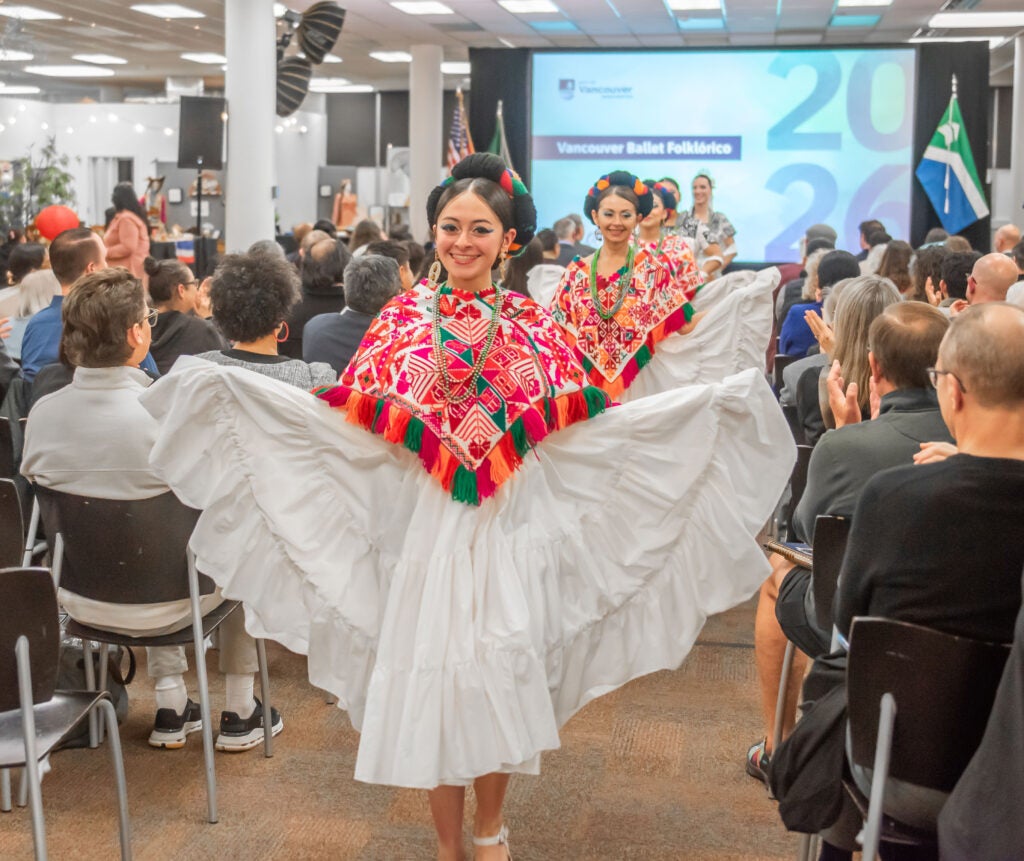
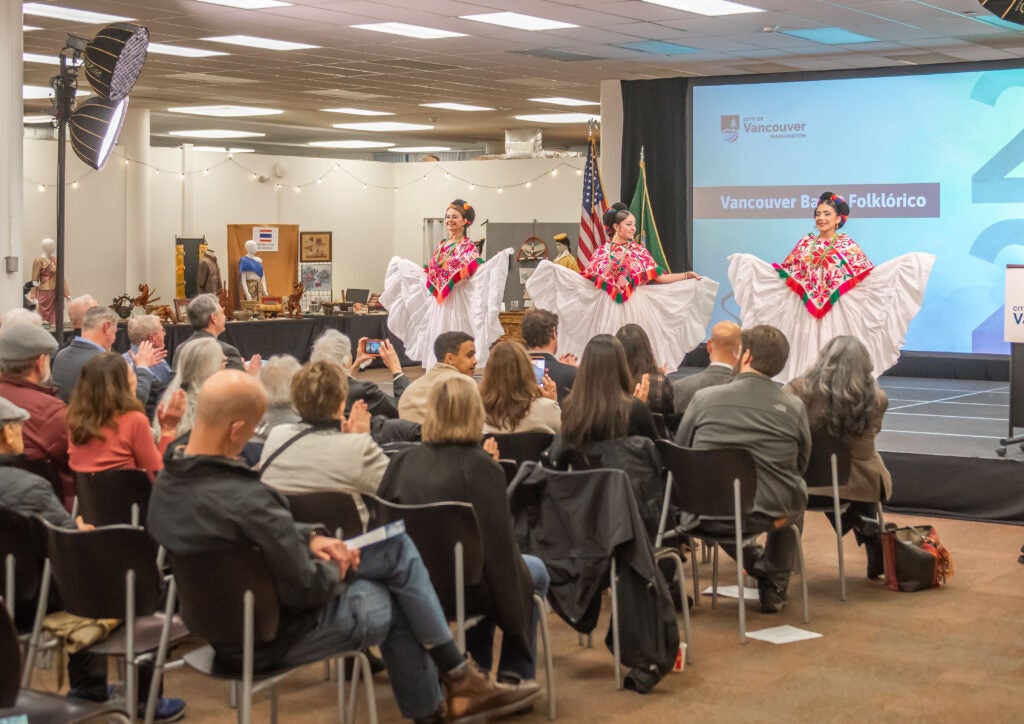
Thank you to Clark County Poet Laureate Susan Dingle, the Vietnamese Community of Clark County, and Evergreen Public Schools Video Services…and to Vancouver Ballet Folklórico, whom I would like to welcome to the stage to close our time together.
Thank you.
Poem by Clark County Poet Laureate
Morning in Vancouver
Susan G. Dingle
Maybe a street corner mural
says it best, “Unity is Strength,”
as I drive south on Washington Boulevard
on the way to where the highways meet
and divide, one south toward the river,
the other north toward the sea.
Equity was never just a word,
but a way of affirming who we are.
In the rain, we stood together on the corner of
Esther Short Park at noon in a vigil
every Wednesday, until daffodils appeared
like an affirmation that no matter how rainy the winter,
our spring will come.
For Vancouver people still offer hospitality,
shelter and provision to all, even when
it’s complicated, to foster the harmony of belonging
on an unceded land once a fortress,
now a port, and yet the old saying still rings true
“e pluribus unum,” out of many one.
We listen and see what that feels like in Vancouver,
how it echoes in every neighborhood,
in every park and playground
where all our children find belonging,
and yes, we all belong.
Photos