

How the Plan Was Developed
Our Vancouver was developed through more than three years of community engagement, technical analysis, environmental review, and public decision-making. From early 2023 through June 2026, the City worked with residents, community organizations, businesses, neighborhood groups, public agencies, boards and commissions, and other community partners to understand what people value about Vancouver, what needs to change, and what people want Vancouver to become. Staff provided regular updates to the City Council, who unanimously approved the plan and zoning code on June 1, 2026.
Phase I – Visioning
This phase of the project focused on gathering input from the community to identify a collective vision for the future of Vancouver as well as understanding our community’s past and present.
The process began with engagement that asked community members: What do you want your community to be like in 20 years? The City used community events, tabling, surveys, a pin map, partner meetings, neighborhood outreach, presentations, and other activities to understand people’s experiences and priorities.A central part of this phase was establishing an advisory group comprised of “Community Partners.” This group worked directly with City staff to help shape engagement efforts, prioritize policy direction, identify community priorities, and connect lived experience with the technical planning process. The project team documented how and where community input could be incorporated into the plan or shared with other City projects.
During this phase, the project team conducted extensive background research and technical analysis to establish a baseline of existing demographic data and trends to inform the development of the plan. The Community Atlas brought together data, maps, and research on Vancouver’s people, natural and built environment, economy, parks and public facilities, and regulatory framework, while the Housing Needs Assessment and Economic Opportunities Analysis examined housing conditions, demographic and household trends, employment, economic conditions, and future needs. These analyses provided a factual foundation for the planning process and helped the community and project team understand not only where Vancouver is today, but the changes and pressures that will shape the next 20 years.
The first phase resulted in a collective vision for Vancouver, the Goals Framework and chapter vision statements, and initial recommendations for policies and programs. This work formed a critical foundation for the remainder of the process and the final plan itself.
Phase II – Land Use Alternative Development
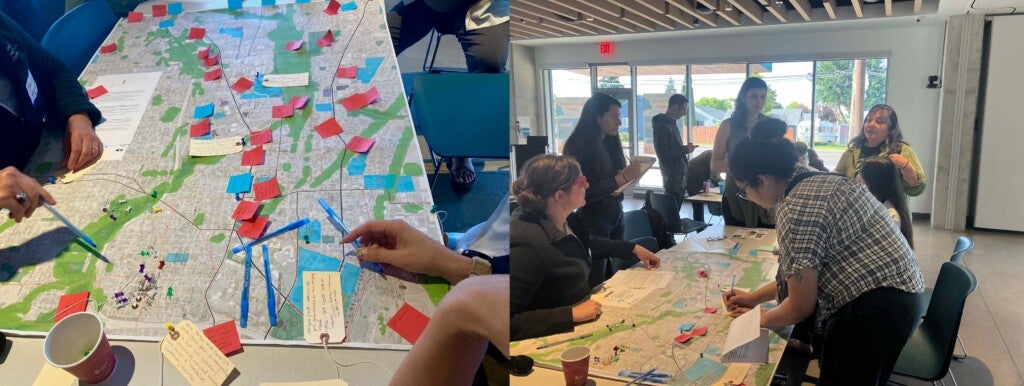
The next phase asked a more specific question: Where and how should Vancouver grow? The City worked with members of the community to explore different land use possibilities through mapping activities, workshops, presentations, tabling, community working groups, and an interactive online map.
The project team held four broad community workshops and additional small group workshops, during which participants identified where different types of housing, jobs, services, and other uses could fit across West, Central, and East Vancouver. The mapping exercise used during the workshops was co-created with community leaders, Community Partners, Planning Commission, City Council, and technical staff.
During this phase, the City also made a deliberate effort to reach people who had been underrepresented in earlier engagement, as outlined in the plan’s equity priority communities.
The input gathered during this phase helped inform the development of land use alternatives that were subsequently evaluated through the environmental review process.
Draft and Final Environmental Impact Statements
The land use alternatives were evaluated through a State Environmental Policy Act (SEPA) Environmental Impact Statement. The City issued a Determination of Significance and conducted an expanded public scoping process before preparing the Draft EIS. The Draft EIS evaluated a No Action Alternative and action alternatives and provided information about potential environmental impacts, beneficial outcomes, and measures to avoid, minimize, or mitigate adverse impacts. The Draft EIS was issued July 8, 2025, followed by a 60-day public comment period. The City received 440 responses representing 409 unique comments, submitted through the online form, email, mail, and voicemail.
The feedback received during this process helped narrow down the action alternatives into the Preferred Alternative, which was evaluated in the final EIS. The Preferred Alternative was refined based on direction from City Council and Planning Commission and was endorsed by City Council on December 15, 2025.
Phase III – Draft Plan and Code
The final phase of engagement focused on reporting back. The City showed community members what had been heard during the earlier phases and how that input was reflected in the draft Comprehensive Plan and updated zoning code.
The draft plan and zoning code were released February 19, 2026. The public could review the documents, explore the Preferred Land Use Alternative through an interactive map, attend presentations, ask questions, and submit feedback through March 31. The City held a series of community presentations, group specific discussions, and workshops with City Council and the Planning Commission to review the Draft Comprehensive Plan and Code. The feedback received during this phase was used to refine the final Comprehensive Plan and zoning code where it aligned with state law, City priorities, and previous community input.
The process combined community knowledge, technical analysis, environmental review, and public decision-making. It culminated with City Council adoption of the Our Vancouver 2026–2045 Comprehensive Plan and updated zoning code on June 1, 2026. The plan and code went into effect on July 31, 2026.
Incorporating Community Input
The project team made significant efforts during each phase to ensure community voices and priorities shaped the plan. During the update process, more than 2,000 people participated directly through more than 200 meetings and events, while thousands more shared ideas through surveys, online tools, written comments, newsletters, and other outreach. Engagement occurred through a variety of formats to reach people across different communities, including:
- Public meetings, small-group discussions, and community events, including forums, tabling, and neighborhood-based outreach
- Interactive mapping activities and online engagement tools to gather place-based input
- Community Partner and Community Working Group meetings
- Workshops with City boards, commissions, Planning Commission, and City Council, where community members could provide testimony and feedback
- Broad digital and citywide outreach, including surveys, StoryMap engagement, newsletters, and social media
- Presentations to community and business organizations, neighborhood associations, schools, service providers, and other public agencies.
Every chapter includes a Community Feedback callout highlighting key themes heard from the community and showing how those themes informed the direction of the Plan.
Equity was a significant part of the plan development and engagement process. The project team was cognizant of who participated, how outreach was conducted to bring these groups in, and how community input influenced the outcomes in the plan. They developed and utilized a co-creative model involving an Equity Team, Community Partners, Community Working Groups, and Technical Working Groups. Under this framework, Community Partners worked with City staff as members of the Equity Team and as community engagement liaisons. The Equity Team reviewed technical recommendations and community feedback and helped ensure that equity remained integrated into plan development. Community Working Groups brought together community representatives, service providers, businesses, advocacy organizations, and others with topic-specific knowledge. These groups worked alongside Technical Working Groups comprised of City staff and consultants to inform recommendations.
This approach to engagement supported ongoing connections with equity priority communities.
Equity was also incorporated into the technical analysis. The City’s Equity Index was used to understand baseline gaps and root causes and to apply an equity lens to the goals and policies in the Plan, as outlined in chapter 2 of the Comprehensive Plan. More detailed information on the engagement process can be found in the engagement summary.